

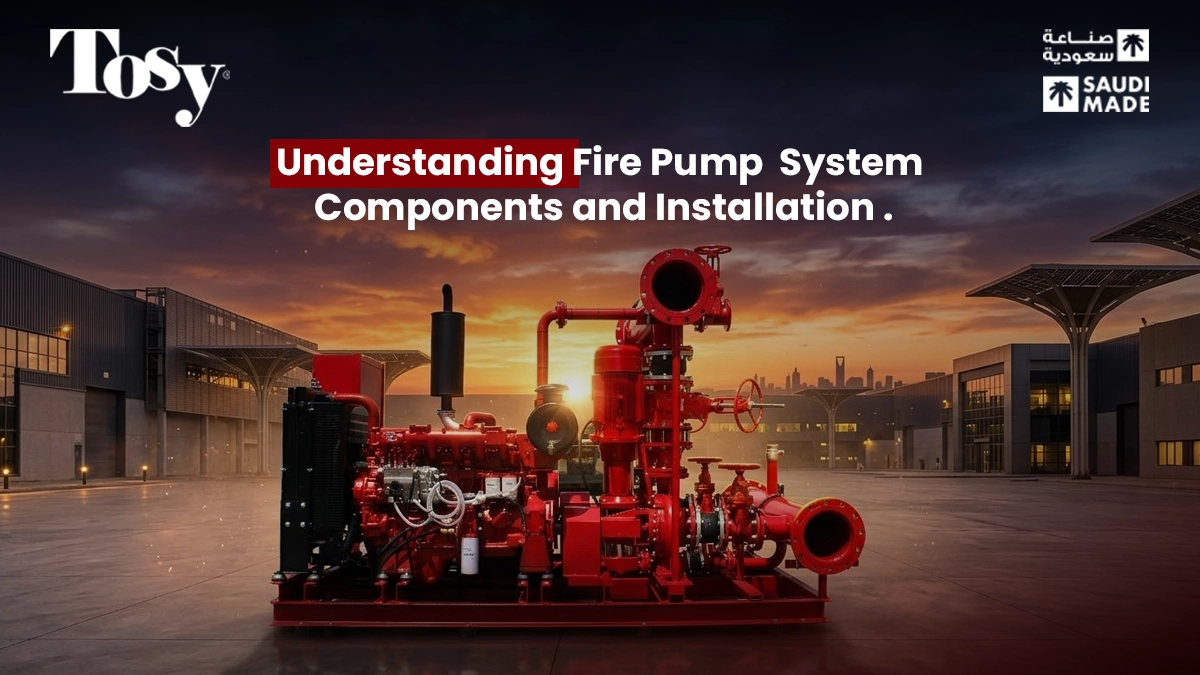

When safeguarding a commercial or industrial facility, having a reliable fire protection strategy is critical. A robust fire pump system acts as the beating heart of this strategy, ensuring that water is delivered at the right pressure and volume exactly when it is needed. This guide breaks down everything from core components to installation best practices.
What Is a Fire Pump System and Why Is It Important?
A fire pump system is an essential part of a building’s fire protection infrastructure. It is designed to intake water from an external source—such as a public utility underground water supply or a static tank—and significantly boost its pressure. This system is crucial because municipal water supplies rarely provide the necessary pressure to combat large-scale fires, especially in high-rise buildings or expansive industrial complexes.
How Fire Pump Systems Work with Sprinkler Systems
The true value of a fire pump system is realized through its integration with automated sprinklers. When a fire breaks out, the heat causes the nearest sprinkler heads to shatter and open. This sudden release of water creates a drop in pressure within the piping network. The fire pump’s controllers detect this pressure drop immediately and activate the main pump, rushing high-pressure water to the active sprinkler heads to suppress the flames before they spread.
Key Components of a Fire Pump Set
A functional system relies on several interdependent parts working flawlessly together.
Pump Unit Centrifugal or Positive Displacement
The pump unit is the mechanical core that moves the water. Centrifugal pumps use a spinning impeller to generate velocity, which is then converted into pressure. Positive displacement pumps, on the other hand, trap a fixed amount of water and force it into the discharge pipe, often used for specialized foam-water systems.
Electric or Diesel Engine
The engine is the driver that powers the pump unit. It must be robust enough to run continuously under extreme stress until the fire is completely extinguished.
Jockey Pump and Controllers
The jockey pump is a small, low-volume pump that maintains the pressure in the system piping to account for minor leaks or temperature changes. The controllers act as the brain of the setup, monitoring pressure levels and commanding the main pumps to start when an emergency occurs.
Pressure Relief Valves and Accessories
To prevent the system from over-pressurizing and bursting pipes, pressure relief valves are installed to safely discharge excess water. Other accessories include flow meters, pressure gauges, and isolation valves.
Types of Fire Pump Sets: Which One Do You Need?
Selecting the right setup depends entirely on your facility’s infrastructure, power availability, and hazard level.
Electric Fire Pump Sets
These are highly efficient, require less maintenance, and are generally quieter. However, they completely depend on a reliable electrical grid and usually require a backup generator to ensure they operate during a power outage.
Diesel Fire Pump Sets
For facilities where power reliability is questionable, diesel fire pump are the ultimate fail-safe. They operate independently of the electrical grid, relying on an on-site fuel tank and dedicated starter batteries to ensure they run when everything else shuts down.
Combined Electric-Diesel Sets
For maximum redundancy, many high-risk facilities install a dual system. The electric pump acts as the primary responder, while the diesel pump serves as an immediate backup if the primary fails or loses power.
Portable or Skid-Mounted Units
Skid-mounted units are pre-assembled at the factory on a single steel base. They arrive on-site with all internal piping, wiring, and controllers already connected, drastically reducing installation time and errors.
Compliance Standards: NFPA, FM Approved & UL Certifications
Safety equipment cannot be left to chance. A reliable fire pump system must comply with NFPA 20, the global standard for the installation of stationary pumps for fire protection. Furthermore, to satisfy insurance providers and local authorities, all individual components should be UL Listed and FM Approved, ensuring they have passed rigorous third-party performance testing.
Fire Pump Installation and Maintenance Tips
Proper installation involves precise hydraulic calculations, ensuring the pump room is adequately ventilated, and verifying that the suction pipe is perfectly aligned to prevent cavitation. For maintenance:
-
Perform weekly “no-flow” runs (10 minutes for electric, 30 minutes for diesel).
-
Schedule an annual full-flow test to verify the pump meets its original performance curve.
-
Regularly check engine oil, cooling loops, and battery health.
Why Choose TOSY Pump for Your Fire Pump Systems?
At TOSY Pump, we take immense pride in being a 100% Saudi national manufacturer. Our fire pump systems are engineered and built by skilled Saudi hands, specifically tailored to withstand the Kingdom’s demanding climate and operational environments. We align completely with Saudi Vision 2030, ensuring that our local industry delivers world-class safety solutions without the long lead times of imported equipment.
Trust TOSY Pump – Saudi Excellence for Any Fire Emergency
We provide end-to-end solutions fully compliant with Saudi Civil Defense and NFPA standards, from technical submittals to on-site commissioning across the Kingdom. Reach out to our local engineering experts to secure your facility today.