

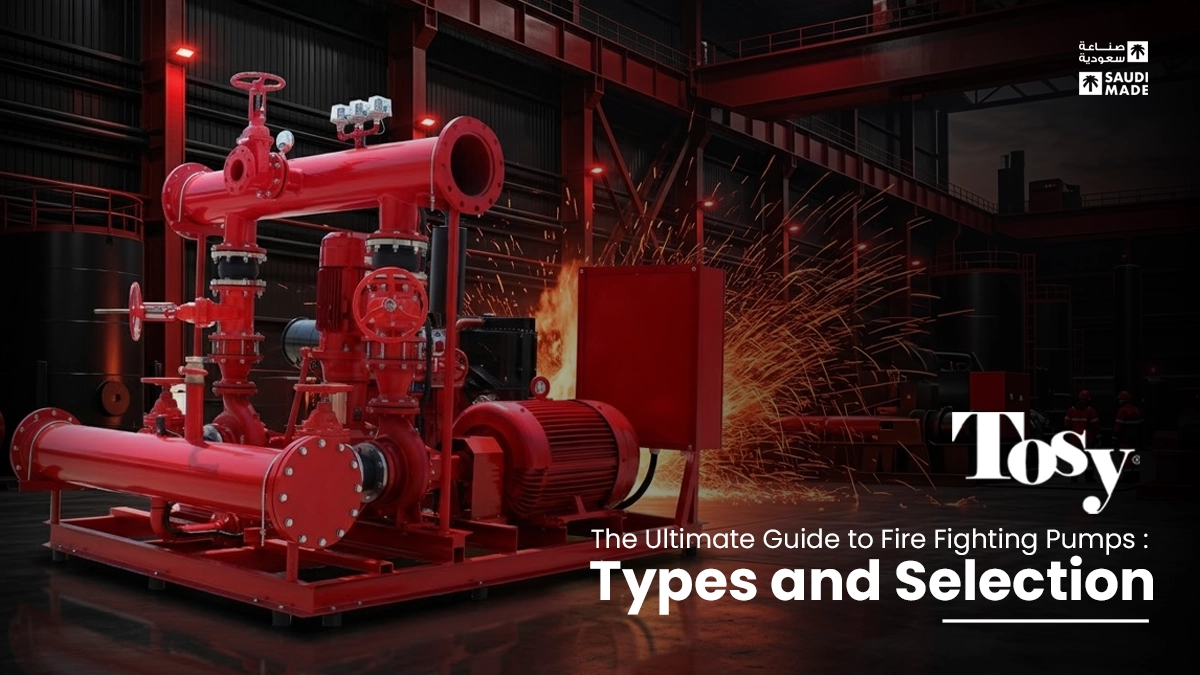

In the wake of Saudi Arabia’s massive urban and industrial expansion under Vision 2030, fire safety has transitioned from a regulatory check-box to a fundamental pillar of infrastructure design. At the core of every water-based fire suppression system lies the fire fighting pumps. These systems act as the primary engine and the “heartbeat” that ensures water reaches every sprinkler head and hydrant with the necessary pressure to suppress fires and protect lives and assets.
As a leading national manufacturer in the Kingdom, we understand that producing fire pumps for Saudi Arabia’s unique environmental conditions requires engineering precision that goes beyond traditional standards. It demands a synergy of high efficiency and the ruggedness to operate under extreme ambient temperatures.
What is a Fire Pump and Why is it Unique?
A fire pump is a specialized mechanical device designed to increase the hydraulic pressure of water in fire protection systems (such as automatic sprinklers, standpipes, and outdoor hydrants).
The Critical Difference: Fire Pumps vs. Domestic Pumps
It is vital for facility managers and engineers to recognize that [fire fighting pumps] are fundamentally different from standard water transfer pumps:
- Continuous Operation: A standard pump is designed to shut down if the motor overheats to prevent damage. A fire pump, however, is engineered to run until the fire is out, even if the motor sustains damage, prioritizing life safety over equipment longevity.
- Certifications: Fire pumps must be rigorously tested and certified by international and local bodies, such as UL (Underwriters Laboratories), FM (Factory Mutual), and the Saudi Civil Defense.
- Performance Curve: They feature a specific performance curve ensuring they provide 150% of their rated flow at no less than 65% of their rated head (pressure).
Key Components of a Comprehensive Fire Pump Set
A professional fire pump system is not a single piece of equipment but an integrated “skid” or “set” consisting of several vital components:
- The Main Fire Pump: This is responsible for providing the full flow during a fire event. It can be powered by an electric motor or a diesel engine.
- The Jockey Pump: A small, high-pressure pump that maintains static pressure in the piping system. It compensates for minor leaks, preventing the main pump from starting unnecessarily.
- Fire Pump Controllers: The “brain” of the system. These panels monitor system pressure and provide automatic start/stop commands and status alarms. They must be fire-rated and highly durable.
- Drivers (Motors/Engines): High-efficiency electric motors or heavy-duty diesel engines equipped with dedicated cooling systems and fuel tanks sized for hours of continuous operation.
- Valves and Accessories: Including non-return valves, relief valves, flow meters, and pressure gauges to ensure safe and measurable operation.
Comprehensive Analysis of Fire Pump Types
Fire pumps are categorized based on their mechanical design and their power source. Understanding these is key to the selection process.
A. Classification by Mechanical Design
- Horizontal Split Case (HSC) Pumps: The most common choice for major commercial and industrial projects in Saudi Arabia. The “split case” design allows the top half of the casing to be removed for maintenance without disturbing the piping. They offer massive flow rates, often reaching thousands of gallons per minute.
- Vertical Turbine Pumps: The ideal solution when the water source is below the pump level, such as deep wells or underground concrete tanks. The impellers are submerged in the water, lifting it vertically to the system.
- End Suction Pumps: Often used in smaller to medium-sized buildings. They feature a compact design and are easier to install in tight mechanical rooms, though they generally offer lower flow capacities compared to HSC pumps.
- Vertical Inline Pumps: Space-saving units that are mounted directly into the pipeline. They are excellent for facilities where floor space is at a premium.
B. Classification by Power Source
- Diesel Driven Fire Pumps: Mandatory in facilities where a reliable electrical grid is not guaranteed or in isolated industrial zones. Our diesel engines are equipped with dual-battery starting systems to ensure they fire up instantly in an emergency.
- Electric Driven Fire Pumps: Favored for their lower maintenance requirements and quiet operation. However, they require a reliable secondary power source (Emergency Generator) as per Saudi Civil Defense regulations.
Compliance with Saudi Civil Defense and Saudi Building Code (SBC)
As a Saudi-based manufacturer, we prioritize local regulations above all else. Compliance is not just a legal hurdle; it is a quality assurance.
The NFPA 20 Standard
Every pump we manufacture strictly adheres to NFPA 20 (National Fire Protection Association), which is the global gold standard for the installation of stationary pumps for fire protection. This standard governs everything from pump room ventilation to fuel tank placement.
The Saudi Building Code (SBC 801)
The Saudi Building Code emphasizes that all fire protection components must be “Listed” and “Approved.” Therefore, we ensure our pump sets utilize components that carry UL/FM certifications, which are prerequisites for insurance approvals and government operational permits in the Kingdom.
Saudi Civil Defense Approval
All fire pump installations in the KSA must be approved by the General Directorate of Civil Defense. This involves rigorous inspections of the installation, testing the automatic start sequence, and verifying the annual flow test records.
How to Select the Right [Fire Fighting Pump] for Your Facility
The selection process is a result of complex hydraulic engineering. Key factors include:
- Hazard Classification: Is the facility Light Hazard (offices), Ordinary Hazard (warehouses), or High Hazard (chemical plants)? The hazard level dictates the required water density.
- Calculating Flow Rate (GPM): Based on the number of sprinklers and fire cabinets expected to operate simultaneously.
- Calculating Pressure (PSI/Head): Engineering must account for “friction loss” in the pipes and the vertical height of the building to ensure water reaches the highest floor at a specific pressure.
- Ambient Environment: In coastal cities like Jeddah or Dammam, we use corrosion-resistant materials. In high-heat areas like Riyadh, we focus on advanced engine cooling systems designed for 50°C+ ambient air.
The Advantages of Choosing a Saudi National Manufacturer
Choosing a “Made in Saudi” fire pump system provides distinct competitive advantages:
- Supply Chain Speed: Instead of waiting months for international shipping, we provide systems in record time, keeping your construction schedule on track.
- On-Ground Technical Support: Our engineers are located in the Kingdom’s major hubs (Riyadh, Jeddah, Dammam), ready for immediate on-site intervention.
- Spare Parts Availability: We maintain a massive inventory of original spare parts, minimizing system downtime.
- Climate-Specific Engineering: Unlike manufacturers in Europe or East Asia, we design our cooling and filtration systems specifically for the desert climate.
Preventive Maintenance: Ensuring 100% Reliability
A fire pump may sit dormant for years, but it must work perfectly the second an emergency occurs. We recommend:
- Weekly No-Flow Test: Running the diesel pump for 30 minutes and the electric pump for 10 minutes to ensure battery health and motor responsiveness.
- Annual Flow Test: A mandatory full-performance test to ensure the pump still meets its rated GPM/PSI curve.
- Oil and Filter Changes: Just like a car, diesel fire pump engines require regular lubrication and filter replacement.
Analyzing Performance Metrics: Flow Rate and Pressure Efficiency
The efficiency of a [fire fighting pump] is measured by its ability to maintain a steady flow under varying pressures. A high-quality pump set minimizes turbulence within the casing, which reduces vibration and mechanical wear over time. By optimizing the impeller design, we ensure that our pumps provide maximum hydraulic output with minimum energy consumption.
Innovations: The Rise of Smart Fire Pumps
As part of the digital transformation in the construction sector, we are introducing “Smart Fire Pumps.” These systems allow facility managers to monitor pump status, fuel levels, and system pressure via a mobile app. Instant alerts are sent if a fault occurs, ensuring that the system is always “Ready for Action.”
Cost-Benefit Analysis: Investment vs. Safety
While fire pumps represent a significant initial investment, the cost of failure is immeasurable. High-quality, certified pumps lower insurance premiums and prevent catastrophic property loss. By choosing a locally manufactured system, you also reduce the “Total Cost of Ownership” through lower maintenance and part replacement costs.
Trust in Quality, Invest in Safety
Choosing a fire fighting pump is a decision that impacts the safety of every person who enters your building. Adhering to NFPA 20 and Saudi Civil Defense standards is not just about compliance—it is about peace of mind.
As a dedicated Saudi manufacturer, we provide end-to-end solutions: from hydraulic design and manufacturing to testing, installation, and long-term maintenance. Protect your investment with a partner who understands the Kingdom’s safety requirements inside and out.
Contact our engineering department today for a customized consultation and technical submittal for your next project.